


Europa Clipper Uses Earth as a Slingshot for Jupiter Mission
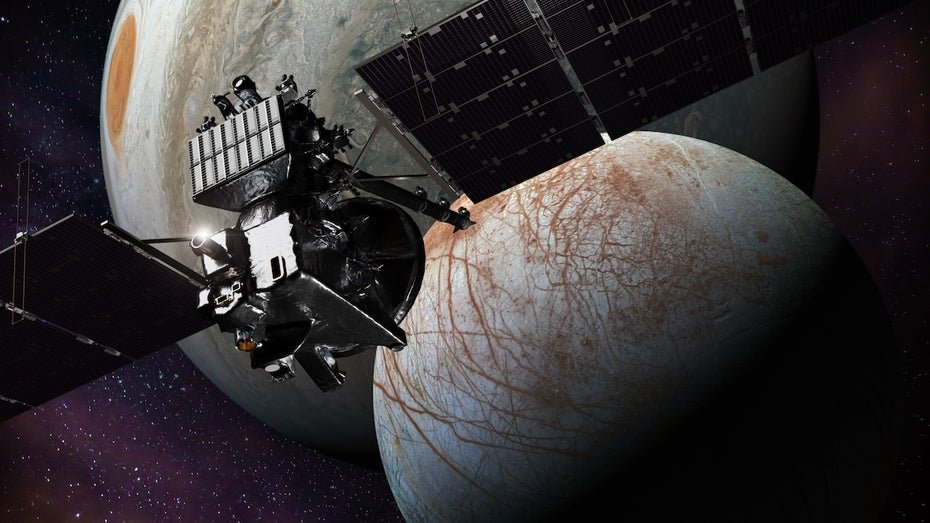
The NASA spacecraft Europa Clipper passed Earth on November 29, 2026, to continue its journey to Jupiter's moon Europa. This technique, known as gravitational assist, allows the spacecraft to gain additional speed necessary for entering orbit around Jupiter. The mission aims to study the planet's icy moons and search for potential conditions for life. Europa Clipper launched over two years ago and has now completed a loop through the inner solar system.
This flyby of Earth is a crucial step in achieving the necessary speed that a launch vehicle alone cannot provide. The spacecraft weighs about six tons and is equipped with a variety of scientific instruments essential for exploring Europa. NASA considers this mission one of the most significant in the history of planetary science. Europa, one of Jupiter's moons, is regarded as one of the most promising locations in the search for extraterrestrial life. Scientists suspect that beneath its thick ice shell lies an ocean of liquid water that could potentially provide conditions for life.
The Europa Clipper mission includes several scientific objectives, such as investigating the chemical composition of the ice crust and analyzing geological activity on the moon's surface. The spacecraft will also measure the magnetic fields and ionizing radiation in Europa's environment to obtain a comprehensive picture of the moon's surroundings. The use of Earth as a gravitational assist is not new but has been particularly effective in this mission. The spacecraft will make additional loops around Earth and other planets in the coming months before finally entering orbit around Jupiter. This technique allows for fuel savings and significantly extends the mission's range.
The Europa Clipper mission is part of a larger program to explore the Jupiter system, which also includes the Juno mission, collecting data about Jupiter since 2016. Juno has already provided important insights into the planet's atmosphere and magnetosphere and will continue to serve as a valuable information source for the Europa Clipper mission. The arrival of Europa Clipper near Jupiter is expected in 2030. The mission is anticipated to last several years as the spacecraft collects and analyzes data. The results could provide crucial clues about the possibility of life beyond Earth.
NASA has emphasized that the Europa Clipper mission is significant not only for science but also for technology development. The instruments and systems developed for this mission could also be used in future missions to explore other celestial bodies. The Europa Clipper mission represents a significant step in the exploration of the solar system and could revolutionize our understanding of life in the universe. NASA plans to release the first scientific data from Europa Clipper in 2031.






💬 Comments (0)
No comments yet. Be the first to comment!