


AMD Unveils Rack Helios to Compete with Nvidia
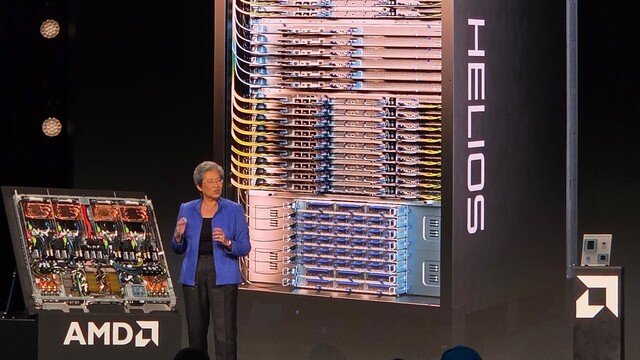
On July 24, 2026, AMD unveiled the Rack Helios, a newly developed rackscale design that is set to enter production. With this move, the company aims to challenge Nvidia's market leadership in the high-performance computing sector. The Helios rack incorporates several technological innovations that AMD has developed over the past few years. The Helios rack is equipped with a variety of AMD EPYC processors that provide high computing power.
These processors are known for their energy efficiency and scalability, making them ideal for use in data centers. AMD has emphasized that the combination of EPYC and the new architecture of the Helios rack enables a significant performance boost compared to previous solutions. A key feature of the Helios design is the integration of AMD Radeon graphics processors, which have been specifically optimized for compute-intensive applications. These GPUs are expected to deliver improved graphics performance and faster data processing, which is crucial for applications in artificial intelligence and machine learning. AMD highlights that the combination of CPU and GPU in a rack opens a new dimension of performance.
The Helios rack also supports high bandwidths and low latencies, which are of great importance for modern cloud services and data analytics. The architecture allows for multiple racks to be interconnected to achieve even greater computing power. This could be particularly beneficial for companies that need to process large amounts of data. Another innovative aspect of the Helios rack is the use of advanced cooling systems that ensure efficient heat dissipation. AMD has ensured that the cooling is both energy-efficient and environmentally friendly.
This could significantly reduce operating costs for data centers while also minimizing environmental impact. The launch of the Helios rack comes in an increasingly competitive environment. Nvidia has made significant strides in recent years and dominates the high-performance computing market. However, AMD sees potential, particularly in providing solutions tailored to specific customer needs. Analysts expect that the Helios rack will not only enhance performance but also lower costs for companies reliant on cloud computing and data analytics.
AMD plans to offer the Helios rack in various configurations to meet different requirements. The first systems are expected to be delivered in the third quarter of 2026. Reactions to the announcement of the Helios rack have been mixed. While some experts praise the technological advancements, others express concerns about market acceptance and competitiveness against Nvidia. However, AMD has emphasized that continuous innovation and adaptation to market needs are a priority.
The introduction of the Helios rack could also impact pricing in the high-performance computing market. AMD has announced that the new systems will be competitively positioned to attract a broader customer base. However, the exact pricing structure will only be revealed upon market launch. Initial tests of the Helios rack show promising results in terms of performance and efficiency. AMD has already announced several partnerships with companies in the technology sector to test the rack in real-world applications.
These tests are expected to be completed by the end of 2026 to ensure that the product meets the high demands of the industry. AMD aims to demonstrate not only technical superiority with the Helios rack but also to reduce Nvidia's market share. The coming months will be crucial to see how the Helios rack performs compared to existing solutions. The market launch of the Helios rack is planned for the third quarter of 2026, and AMD expects it to play a significant role in the competition for market leadership in high-performance computing.






💬 Comments (0)
No comments yet. Be the first to comment!