


Mars Express Discovers Metallic Shimmering Dunes
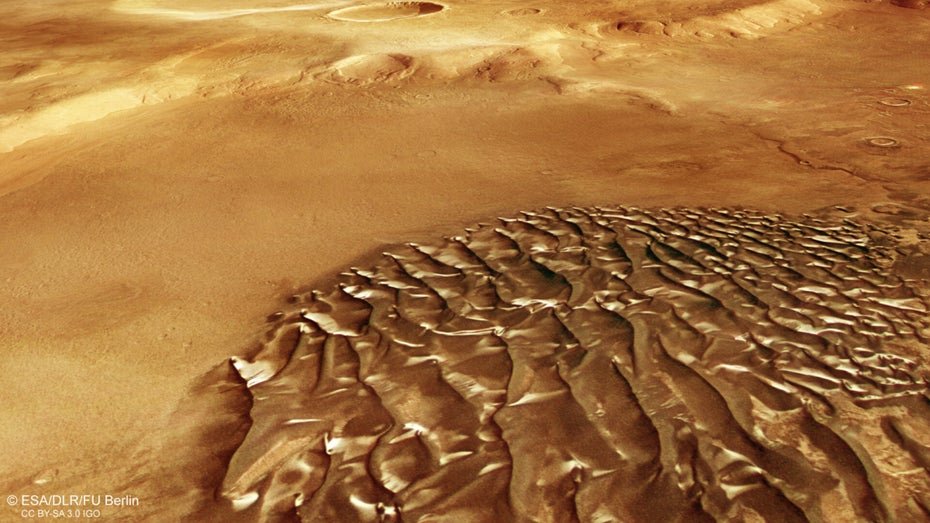
New images from Mars Express reveal impressive metallic shimmering dunes in the Kaiser Crater on Mars. These images were released on July 19, 2026, and show structures that appear to be like liquid metal at first glance. The pictures were taken with the spacecraft's high-resolution camera, which has been exploring the Red Planet since 2003. The dunes in the Kaiser Crater are part of a larger geological formation that extends over several kilometers.
These structures are not only visually striking but also provide valuable information about the geological processes occurring on Mars. Scientists suspect that the metallic appearance is caused by the reflection of sunlight on mineral surfaces. The Kaiser Crater itself has a diameter of about 40 kilometers and is an example of the diverse geological features found on Mars. The images show that the dunes have a complex structure shaped by wind and other atmospheric conditions. These findings could help deepen the understanding of the Martian atmosphere and its development.
The images were created as part of the ongoing Mars Express mission, which aims to investigate the geological and atmospheric properties of the planet. The mission has already made numerous discoveries, including evidence of water and organic molecules. These new images expand knowledge about the surface characteristics of Mars and its climatic conditions. Scientists from the European Space Agency (ESA) have emphasized that analyzing these dunes could provide important clues about Mars' history. The metallic shimmering dunes may indicate mineral deposits formed by volcanic activity or other geological processes.
This information is crucial for understanding Martian geology and the planet's potential habitability. The images were released at a time when global interest in Mars missions is increasing. Various space agencies, including NASA and ESA, are planning future missions to further explore Mars. These missions could also investigate the possibility of a manned Mars mission in the coming decades. The new images from Mars Express are further evidence of the advanced technologies being employed in space exploration.
The spacecraft's high-resolution camera allows scientists to capture details that were previously unreachable. These technological advancements are essential for the exploration of Mars and other celestial bodies. The ESA plans to continue analyzing the data from Mars Express and share the results with the scientific community. The mission is expected to continue at least until 2028 to gain further insights into Mars. The new images could also form the basis for future research projects.
The metallic shimmering dunes in the Kaiser Crater are a fascinating example of the geological wonders of Mars. This discovery could further ignite interest in Mars research and raise new questions about the planet's development. The ESA has announced that further analyses of the images will be conducted in the coming months. The next steps in Mars research may also include the development of new technologies for analyzing the Martian surface. Scientists hope that future missions will provide even more detailed data about the geological processes on Mars.
Thus, the discovery of the metallic shimmering dunes could be just the beginning of a series of exciting findings. The ESA has described the new images from Mars Express as a significant advancement in Mars research. These images could help better understand the geological processes on Mars and support the search for signs of life on the planet. Upcoming missions to explore Mars are already in planning, with ESA and other space agencies working on developing new technologies. These developments could significantly expand the possibilities for exploring Mars. The ESA has announced that it will publish the results of the current mission by the end of 2026.







💬 Comentarii (0)
Inca nu exista comentarii. Fii primul!