


ESA Investigates Deformed Asteroid Following DART Mission
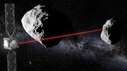
The European Space Agency (ESA) has announced plans to investigate the asteroid Dimorphos, which was successfully deflected and deformed by the NASA DART mission. Launched in September 2022, the DART mission aimed to test humanity's ability to divert potentially hazardous asteroids from their paths. Dimorphos, a small moon of the asteroid Didymos, was not only deflected by the impact of the DART spacecraft but also physically altered. NASA reported that the original flattened rock of Dimorphos was transformed into an elongated shape resembling a rugby ball due to the impact. This unexpected deformation could affect the asteroid's stability, as it may begin to tumble.
Such changes could influence the future trajectory of the asteroid and are therefore of great interest to scientists. The ESA plans to send its Hera spacecraft to Dimorphos in 2027 to collect detailed data on the effects of the DART mission. Hera will be equipped with various instruments to analyze the surface characteristics and geological features of the asteroid. This mission is considered crucial for deepening the understanding of asteroid dynamics and their potential threats to Earth. The DART mission has not only demonstrated the deflection of an asteroid but has also provided new insights into the physical properties of asteroids.
Scientists have found that the structure of Dimorphos was significantly altered by the impact, raising questions about the composition and stability of such celestial bodies. The results could also be relevant for future asteroid defense strategies. The ESA has emphasized that the Hera mission will not only investigate the impacts of the DART mission but will also provide an opportunity to better understand the formation and evolution of asteroids. The data collected could help improve models for predicting asteroid properties and more accurately assess risks to Earth. The DART mission has garnered global attention and is regarded as a significant step in planetary protection research.
NASA has already released preliminary results indicating that the deflection of Dimorphos was successful. However, the change in the asteroid's shape could pose new challenges for future missions focused on exploring and protecting Earth from asteroids. The ESA will announce further details about the Hera mission in the coming months, including specific scientific objectives and planned technologies. The mission is expected to provide a wealth of data that will be of interest to the international community, particularly regarding Earth's safety. The DART mission has demonstrated that humanity is capable of actively responding to potential threats from space.
However, the changes observed in Dimorphos may also raise new questions that will need to be addressed in future research projects. The ESA and NASA are working closely together to analyze the results of the DART mission and plan the next steps in asteroid research. The ESA has already announced that the Hera mission is set to launch in 2027 to reach Dimorphos and gather comprehensive data. This mission is seen as an important step in the exploration of asteroids and their potential dangers to Earth. NASA has deemed the DART mission a success, as it not only demonstrated the deflection of an asteroid but also provided valuable information about the physical properties of asteroids. The changes to Dimorphos will continue to be studied to better understand the implications for future missions and Earth's safety. The ESA plans to publish the results of the Hera mission in 2029, after the spacecraft has collected and analyzed its data.






💬 Comentarii (0)
Inca nu exista comentarii. Fii primul!